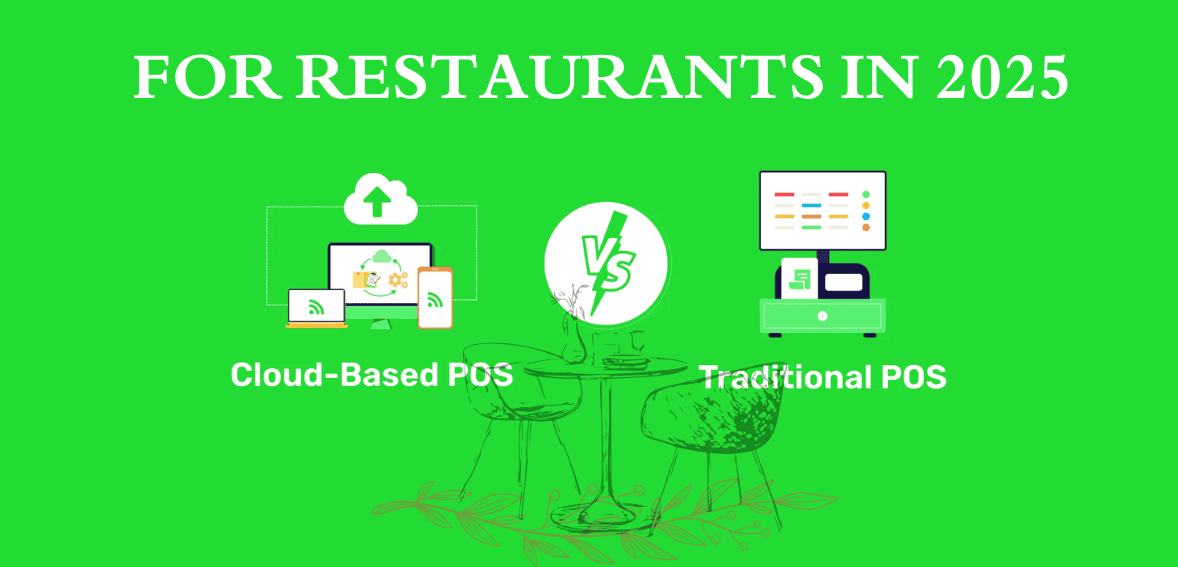
Cloud-Based POS vs On-Premises POS for Restaurants in 2025
The selection of a point-of-sale system has become a strategic decision for restaurants in 2025. The cloud-based POS vs on-premises POS is a never-ending argument among the various and at the same time the most contagious issue of the whole POS decision-making process. It is definitely one of the technology debates that has the most impact on customer expectations and operational complexity, which keeps evolving.
The existence of such a debate is still relevant. The majority of the restaurant owners have already made up their minds to the fact that they won’t only have software for billing. They would rather have systems that can also handle online ordering, real-time reporting, multi-location management, and seamless integrations.
Modern-day restaurant POS systems have become the backbone of daily operations, thus influencing the overall staff efficiency and the customer experience. The decision to go with either a cloud or an on-premise solution could have a far-reaching effect on the business scalability, data access, security, and long-term expenses involved. In the meantime, the cloud-based platforms do promise flexibility and remote access. On the other hand, the conventional on-premise setups continue to attract those operators who like control and appreciate the reliability of working offline.
Before going ahead with the investment, it is very important to know both the pros and cons of cloud POS and on-premise POS for restaurants. This blog with help with the most critical differences, use cases, and trends that will be shaping restaurant technology in 2025.
Cloud-Based POS vs On-Premises POS: Core Technology Differences
Data storage, processing, and location primarily drive the cloud-based POS vs on-premises POS comparison. Cloud-based systems use the internet to gain access to served and connected servers, which means data can be stored far away and accessed anywhere. On-premises systems save their data on their equipment, for instance, back-office servers or terminals, within the restaurant.
Usually, with a cloud POS system for restaurants, software updates, data backups, and maintenance are taken care of by the vendor. Thus, there are fewer technical problems to deal with for the restaurant owner. Conversely, in-house POS software needs either in-house IT personnel or outsourcing to an external service provider to support the company with managing updates, providing security patches, and system maintenance.
The way each of these architectures is set up brings about their different but at the same time interdependent aspects of performance, accessibility, and cost. Cloud systems lead in flexibility and real-time access, while local control is prioritized in the case of on-premise systems. Having this basis is very important before the comparison of the features, costs, and scalability of the various modern restaurant POS systems is done.
Cloud-Based POS vs On-Premises POS: Cost Structure and Long-Term Pricing
In the case of a cloud-based POS system vs on-premises counterpart, the cost is the main factor that is taken into account. Generally, the subscription model is adopted for the cloud-based solutions, which are charged on a monthly or yearly basis depending on the features and the locations. This approach significantly reduces initial costs as well as renders budgeting more predictable.
In contrast, on-premise POS software typically has a larger upfront investment. Investments may be for hardware, licensing, installation, and maintenance. Even though recurring fees may come out to be lower, other costs for repairs or upgrades may surface over the time period.
For a lot of restaurants, the cloud POS for restaurants is a financial boon, especially for startups or developing brands. Thus, financial flexibility is given to them. On the other hand, the established restaurants with stable operations may consider it a long-term investment to have their system fully owned by them. When restaurant POS systems of 2025 are evaluated, the importance of their total cost of ownership over several years cannot be neglected.
Cloud-Based POS vs On-Premises POS: Scalability and Multi-Location Management
Cloud-based POS vs on-premises POS comparison brings out the migration point really well in terms of scalability. Businesses step up to the occasion at a pace dictated by their cloud-based systems. Locations, menus, or users can often be added remotely with little or no disruption at all.
Cloud POS for restaurants enables centralized reporting, menu updates, and pricing changes across all locations in real time for multi-unit operators. This level of control is difficult to achieve in a traditional POS system setup.
On the other hand, scaling up on-premise POS software will typically mean the installation of new hardware and independent configuration of systems at every location. The whole process can turn out to be a big bite both in terms of time and money. Despite that, on-premise systems are capable of providing excellent service to single-location eateries. Cloud-based restaurant POS systems will definitely be the preferred option for businesses that are looking to expand in the year 2025.
Cloud-Based POS vs On-Premises POS: Reliability and Internet Dependency
In the cloud-based POS vs on-premises POS argument, reliability comes first as a common concern. There are worries about the downtime that would be caused by the unstable internet connection on which the cloud-based systems are reliant. Nevertheless, a large number of modern cloud POS for restaurants have started to incorporate offline modes, which enable the performance of basic operations even during power outages.
On-premise POS software does not require internet access. Thus, it is preferred in places where connectivity is poor. Transactions, orders, and reports can still be done and will not be interrupted because they are working offline.
But, still, local systems can experience problems. If there are no backups done correctly, hardware failure or data corruption can lead to downtime. By 2025, the differences in the reliability of cloud and on-premise restaurant POS systems will have reduced substantially, making them both possible choices when correctly implemented.
Cloud-Based POS vs On-Premises POS: Data Access and Real-Time Reporting
Having access to data is essential in every part of modern restaurant management, so that it can be the deciding factor when the cloud-based POS vs on-premises POS are compared. Real-time data access to sales, stock levels, and performance metrics is available through the cloud solution on any device.
Cloud-based POS for restaurants allows owners and managers to control processes from afar, see changes over time, and choose the right actions through their decision-making power. This feature is especially beneficial for large brands or owners who are not always present.
On the other hand, on-premise POS systems usually allow access to the data only from terminals located on-site, unless remote access solutions are set up and configured. Reports often require printers or scheduled updates for data to be sent. For data-driven restaurants, cloud-based restaurant POS systems definitely offer more agility and insight than traditional ones do.
Cloud-Based POS vs On-Premises POS: Security and Compliance Considerations
Security issues are very often a determining factor when deciding between cloud-based POS vs on-premise POS. The data centres of Cloud-based providers are usually very well protected through encryption, compliance certifications, and regular security audits, which are part of their investments. This has the potential to be a very strong and effective security guard against data breaches.
Nevertheless, there are still some operators who are in favor of the on-premise POS solution because it provides them with complete power over their data storage. This can be perceived as safer, particularly for companies that have little trust in third-party hosting.
The fact is that both of these systems can be made secure as long as they are managed properly. Restaurant Cloud POS continues to lower the security maintenance burden, whereas on-premises systems become more secure only with strict internal protocols. By the year 2025, the decision on which restaurant POS trend systems to use should totally depend on the risk management capability and not on the security assumptions.
Cloud-Based POS vs On-Premises POS: Integration with Modern Restaurant Tools
The comparison of cloud-based POS vs on-premises POS, integration capabilities are one of the main factors that should be taken into account, besides the very presence of such systems. Also, besides these systems, the restaurants have various other tools like online ordering systems, delivery apps, loyalty programs, and accounting software that they depend on these days.
Many times, the restaurant cloud POS systems come with open APIs that make integrations faster and more hassle-free. One of the significant advantages that restaurant cloud POS has over other POS systems is that it can synchronize data between different platforms instantly, and at the same time, the manual workload is cut down.
On-premise POS software has the potential to fuse with different systems. However, the integrations are most of the time limited or need custom development. These scenarios can slow down the creation of new services and raise the costs of running the business. In 2025, leaving the evolution of the digital ecosystem aside, embracing larger clouds will be better for giving them flexibility as well as readiness for the future.
Cloud-Based POS vs On-Premises POS: Ease of Use and Staff Training
Often, ease of use in the cloud-based POS vs on-premises POS discussion gets neglected; however, it has a direct impact on day-to-day operations. In general, Cloud-based systems are equipped with user-friendly interfaces and have regular updates for usability.
With the help of cloud POS for restaurants, new employees’ training takes less time, and the updates are done automatically. This consequently helps in reducing the learning curves and operational friction.
In contrast, the POS software installed on the premises might be on outdated interfaces that take longer to train the people. The updates are rather infrequent and could require manual installation. In the busy atmosphere of eateries, modern restaurant sales systems that focus on usability can significantly enhance both the effectiveness and the happiness of the personnel.
Cloud-Based POS vs On-Premises POS: Best Fit by Restaurant Type
The choice between a cloud-based POS vs on-premises POS system usually depends on the restaurant type. Fast-food restaurants will get the most out of cloud systems that can handle a high number of transactions and also support digital ordering. On the other hand, fine-dining restaurants will enjoy the advantages of real-time table management and reporting.
Moreover, small and single-location restaurants that have a long-established menu may still consider the on-premises POS software as a necessity. In contrast, growing brands, franchises, and delivery-oriented concepts are switching to cloud POS for restaurants more often.
There cannot be one surefire solution that would apply to every situation. The determining factor for picking the best restaurant POS systems in 2025 would be the alignment of the needs of the business with the functionalities of the system.
Conclusion
The selection of cloud-based POS over on-premises POS is now considered a technological issue at all times—it’s a strategic decision that can have a major impact on the restaurant’s operational and customer service side. When the restaurant industry suffers from a competitive environment, staff problems, and demanding clients, the POS system used should support the business activities and consequently act as a factor of growth. On top of that, cloud-based POS systems come with flexibility, enhanced access, and real-time data as their major features. Hence, it is the most preferred option for the tech-savvy and modern needs-driven restaurants.
Conversely, the traditional systems still find their users among the operators who consider local control and the reliability of an offline system to be their main criteria. At the end, the most excellent restaurant POS systems are the ones that fit the operational model of the restaurant, budget, and future goals. The restaurant owners in 2025 and beyond will notice that the distinctions between local POS software and cloud-based POS systems for restaurants will be the ones making absolutely future-proof choices.
FAQs
Differentiate cloud-based POS vs on-premises POS?
Cloud-based POS stores data online and allows remote access, while on-premises POS stores data locally on restaurant hardware.
Which is better for restaurants in 2025, cloud or on-premise POS?
Cloud POS for restaurants is better for scalability and real-time insights, while on-premises POS suits stable, single-location setups.
Are cloud POS systems reliable without internet access?
Most of the contemporary restaurant POS systems that are cloud-based have offline functionalities that enable limited activities even during blackouts.
Does the cloud POS system cost more than the on-premises POS software?
In general, cloud POS has reduced initial costs but has regular subscription payments as its cost. Moreover, on-premises POS requires all the maintenance costs with no payment to be repeated.
Is it possible for an on-premises POS system to effectively work together with online ordering?
The integration of POS with an online ordering system is possible in some cases. But restaurant cloud POS still gives the best solution for such integration due to providing an easier and more flexible connection through its SaaS based technology.